
Leading Everest
Reach the Summit. Bring Everyone Home.
One mountain. Six roles. Nobody has the full picture. Lead your team up Everest and get everyone safely back down.
- 1 to 6players
- About 1 hourto play
- 6 roleseach with private facts
- In the browsernothing to install
Start a team climb
Free demo, or the full climb with a codeFree demo: the first 2 days, one player with computer teammates. The full climb and the debrief are paid. See pricing.
Several teams? Open a facilitator session or book one. For learning only, never for appraisal. Your data.
See how your team really shares, decides and listens. Then get better at it.
Leading Everest puts your team in a place where nobody has all the information needed to succeed. Each person sees something different. Some information must be shared. Some must be asked for. The team must decide what matters, when to act and when to turn back. The game captures what happens during the climb and uses that evidence in the debrief. No climbing experience is required.
Who is Leading Everest for?
For teams that make important decisions together and want to understand how they communicate, challenge ideas and make decisions.
A shared experience that helps people build trust and learn to work effectively across functions, locations and perspectives.
For new managers, emerging leaders, high-potential leaders and graduate programs.
A ready-to-run experiential simulation for leadership programs, workshops, offsites and team development sessions.
- 1 to 6people in a team, 3 or more is best
- 1 to 10teams in a facilitated session
- 2 hourswith the briefing and the debrief
- Onlineand browser-based
By the end of the session, participants will be able to:
- 1UnderstandExplain how a fact that only one person holds changes a team decision, and what it costs when that fact arrives late.
- 2ApplyUse questions to draw out information that teammates hold but have not shared.
- 3AnalyzeIdentify what made it easy or hard to speak up about a risk, a symptom or a disagreement during the climb.
- 4AnalyzeDistinguish personal goals from the team goal, and point out where the two were in conflict.
- 5EvaluateJudge the quality of the team's decisions under incomplete information, competing goals and limited time, including whether it kept the rules it had agreed.
- 6CreatePlan one specific change in how the team shares information, asks questions and makes decisions at work.
Six competencies, observed from what the team did, mapped to Korn Ferry, SHL, SHRM, CIPD and the World Economic Forum skills. What it measures.
The climb takes about an hour. The learning continues after it.
The debrief connects what happened in the game to how the team works in the real world.
Play the climb. See the evidence. Have the conversation.
- A debrief based on what the team actually did, not on what people remember doing.
- A record of information shared, information asked for, and information that never reached the team.
- Each person's part: cards shared, questions asked, concerns raised and actions taken.
- Questions that connect the experience to everyday team behavior.
- A printable report for further discussion and follow-up.
Built around the way teams actually make decisions
Teams do not always fail because they lack knowledge. Sometimes the person with the information does not share it. Sometimes nobody asks. Sometimes someone speaks up but is not heard. Leading Everest makes these behaviors visible.
Everyone holds a piece of the picture
The doctor knows who is struggling. The weather specialist knows what is coming. The guide understands the route and the oxygen. No single player sees everything.
The team has to communicate
Each day brings decisions that one person cannot solve alone. Information only becomes useful when it reaches the team.
Goals can pull in different directions
The filmmaker has a contract to fulfill. The client wants the summit. The leader must manage the expedition. It succeeds only when the team gets home safely.
The summit is only halfway
The team has eight days, limited resources and a narrow summit window. Reaching the top is not the end. Everyone still has to come down.
The moment of truth
Near the summit, the turnaround time arrives. The team agreed on a rule earlier. Will it follow the rule, or chase the summit?
The game remembers what happened
Leading Everest records key team behaviors, so participants can examine what actually happened and not only what they believe happened.
Six roles. Six perspectives. One mountain.
Every player sees the mountain differently. Each role has information the others do not have. That creates the conditions for real teamwork, communication and decision-making.

Expedition leader
You lead the expedition, coordinate the team and make the final call each day.
You see: The expedition schedule, rules and deadline.
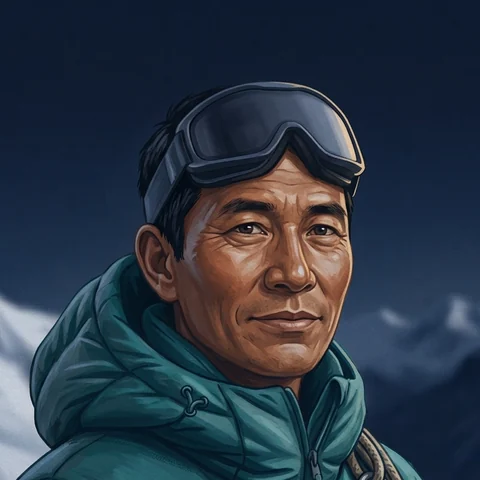
Lead guide
You understand the route, the ropes, the oxygen needs and the conditions on the mountain.
You see: Route conditions, safety limits and oxygen information.
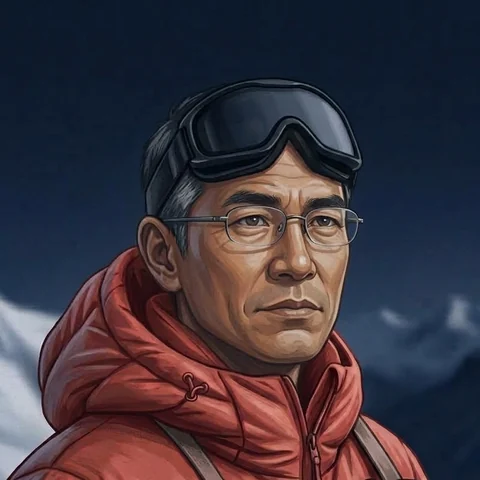
Team doctor
You are responsible for the health and wellbeing of the team. You carry the medical kit.
You see: The true strength of every climber, each morning.
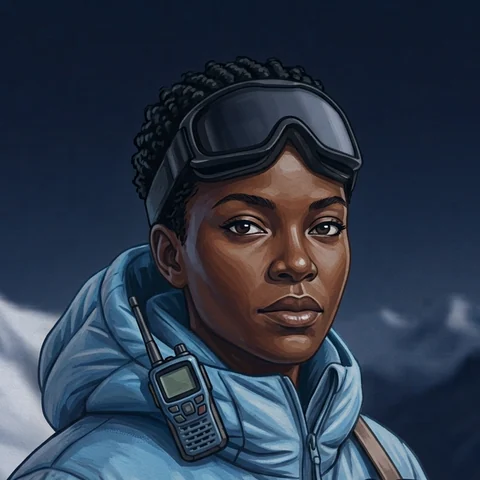
Weather and radio
You monitor the weather and keep the radio link with Base Camp.
You see: Wind and snow forecasts for the days ahead.
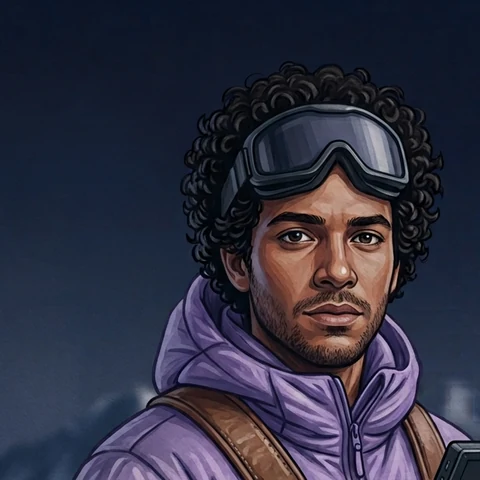
Filmmaker
You are documenting the expedition and must deliver the shots your contract lists.
You see: Your film's shot list and what it requires.

Client climber
This is your first climb above 8,000 meters. You have invested heavily in reaching Everest.
You see: How you are really feeling, and your own medical history.
How to play: the game manual
Read this once before your first climb. It takes about five minutes. The same manual is inside the game, under Help.
The expedition succeeds only when all six climbers return safely. The summit comes second.
A day in six steps
The climb has eight days. Every day follows the same six steps.
- 1Read your cards
Each morning you receive information that only you can see.
- 2Share what matters
Put important facts on the team board so everyone can use them. Saying a fact aloud is not enough: if it isn’t on the board, the game doesn’t know it.
- 3Ask
Ask teammates what they know. Some information only comes out when someone asks.
- 4Decide together
The team discusses the situation and gives its views. The expedition leader makes the final call.
- 5Move together
The leader sets the plan: climb, stay or go down. The whole team follows it. Every plan is written into Talk and at the top of the day report. If you disagree, say so before you lock in.
- 6Lock in
When everyone is ready, the day plays out and the team sees what happens next.
The screen, part by part
A picture of each part of the game, what it is for, and what to do there.
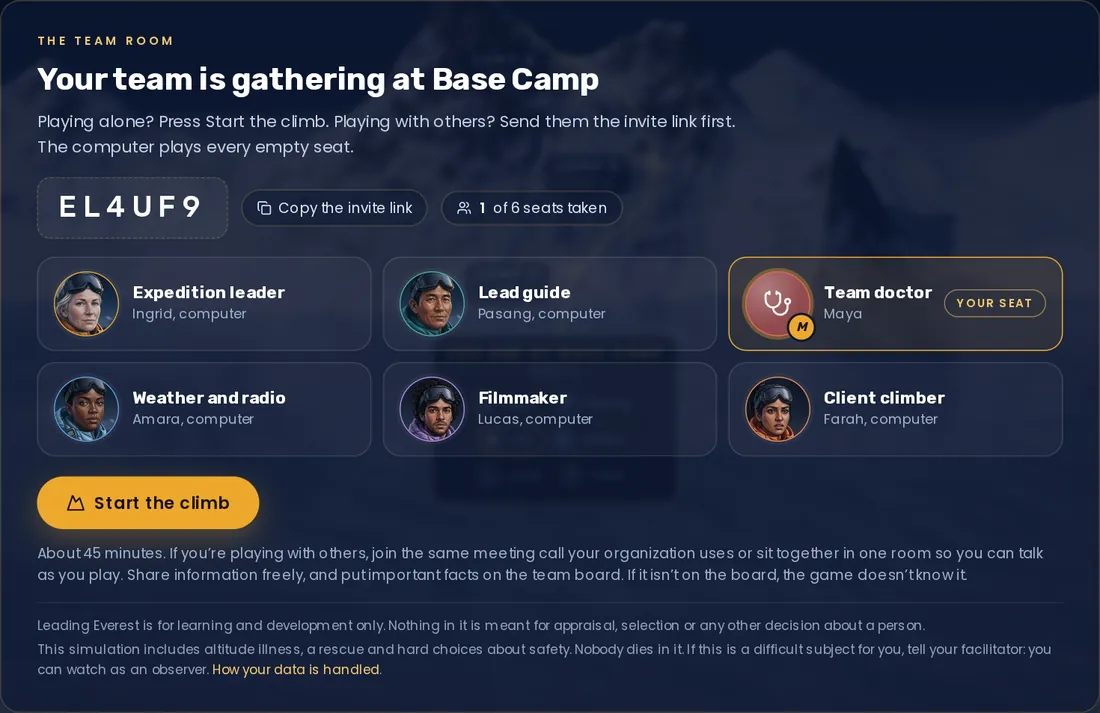
Where the climb begins. The team gathers here before the start.
- Playing alone? Press Start the climb. The computer plays every empty seat.
- Playing with others? Send them the invite link first. Each person takes one role.
- Join the same meeting call your organization uses, or sit together in one room, so you can talk as you play.
- Allow about an hour to play.
- Only the person who opened the room can start the climb.
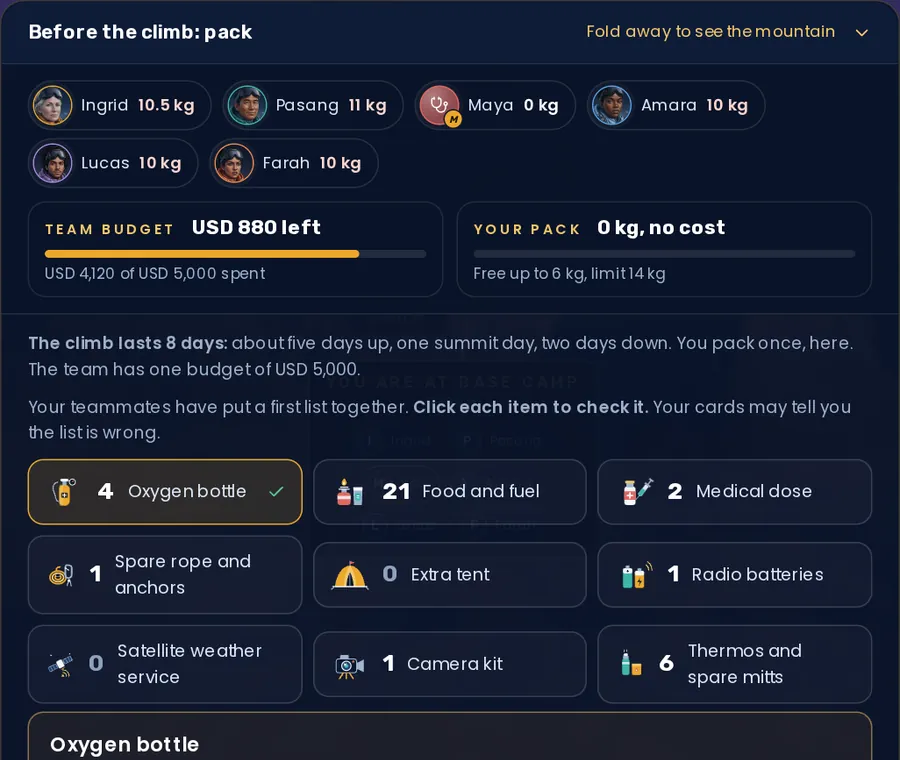
Before day 1 the team packs once. Nothing can be bought on the mountain.
- The top strip shows what every climber carries, the team budget and your own pack.
- Click each item. A box opens and says what it does, what it costs and how long it lasts.
- When every item has a green tick, press Accept the list and start.
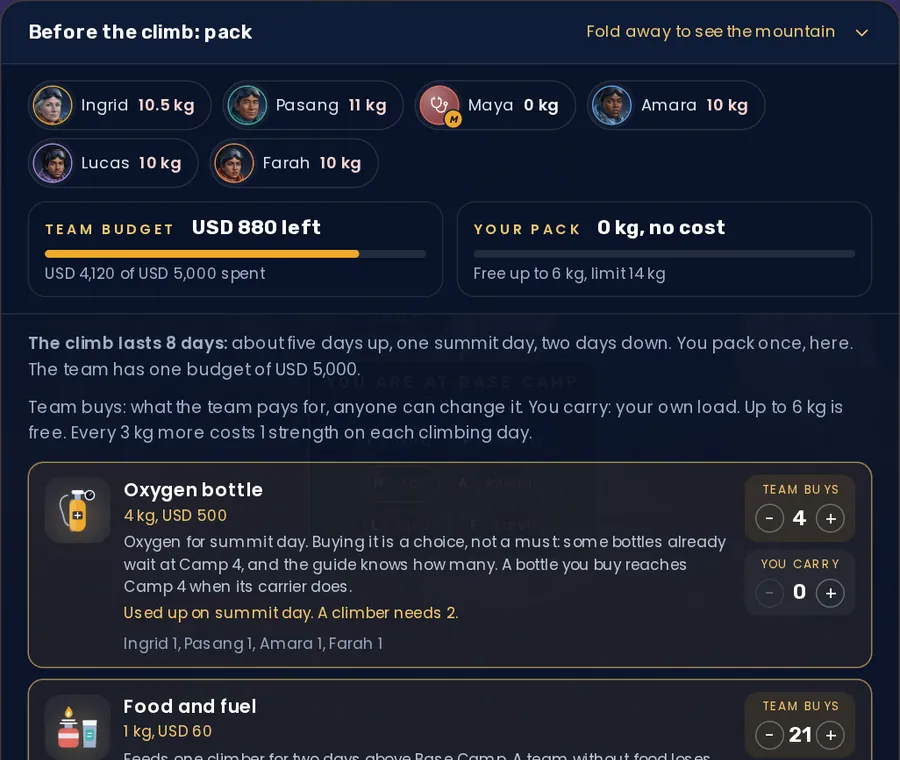
Press Change the list or my pack to open the full list.
- Team buys: what the team pays for. Anyone can change it.
- You carry: your own load. Up to 6 kg is free. More weight costs strength on each climbing day.
- If the money runs out, a red message appears under the budget.

Always in view while you play.
- Days 1 to 8: the gold circle is today.
- The status shows the step of the day and the weather.
- Restart opens a new climb. Help opens this guide and the rules.
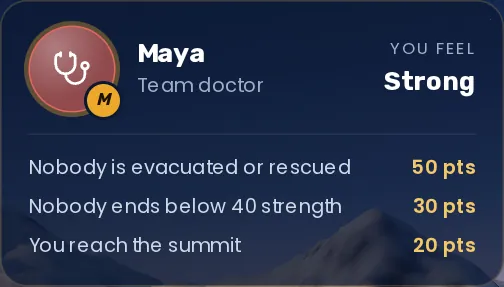
Top left. Your role, how you feel today, and your three personal goals.
- Your goals are private. They can pull against what the team needs.
- How you feel is your own strength in a word: Strong, Tired, Worn down, Unwell or In danger.
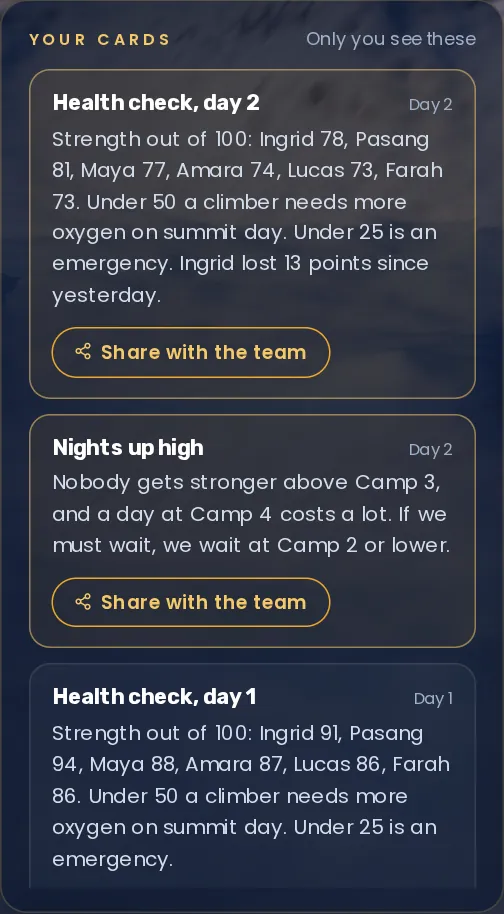
Left side. Facts that only you can see. New ones arrive each morning.
- Read them first.
- Press Share with the team to put a card on the team board.
- A fact that stays here cannot help the team.
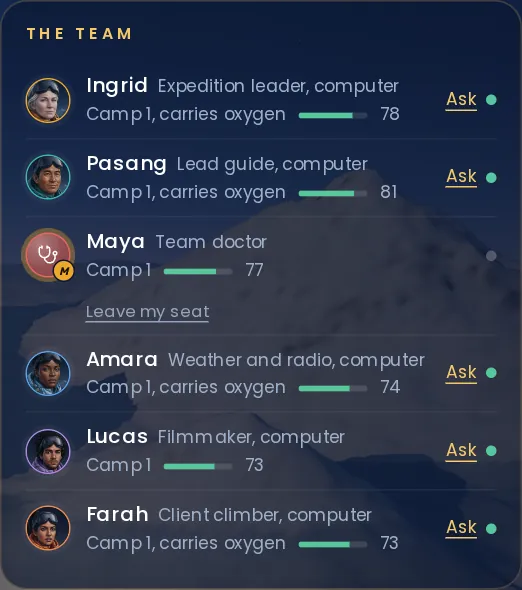
Top right. Where each climber is and what they carry.
- The green bar is a climber's strength. It shows only after the doctor shares the health check.
- Press Ask beside a name to ask that person what they know. Some facts only come out when someone asks.
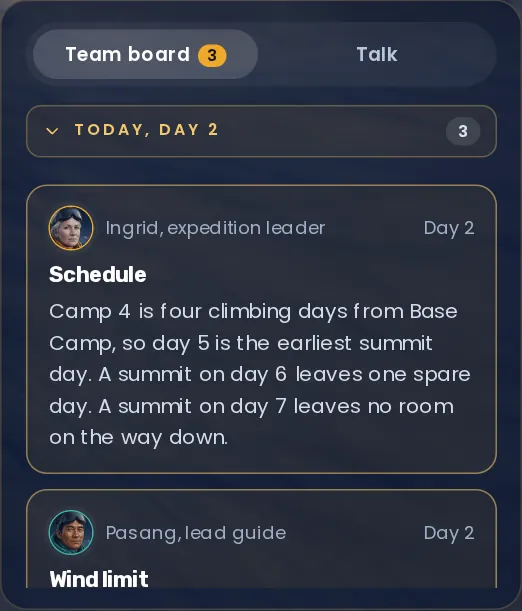
Bottom right. Every card that has been shared, for everyone to read.
- Today is open. Click an earlier day to open or close it.
- The game only knows what is on this board. It cannot hear what you say to each other.
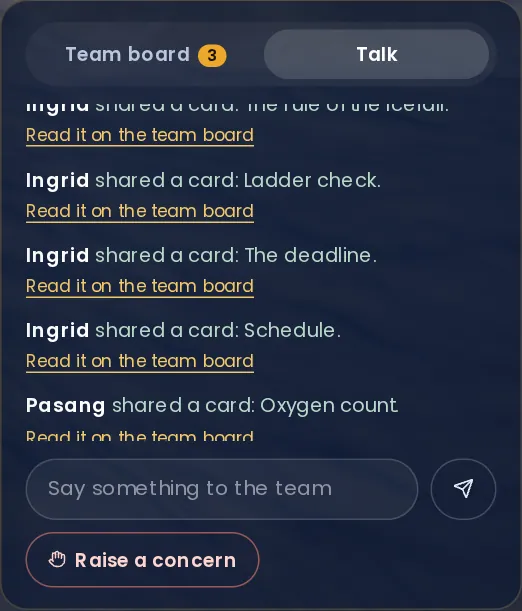
The second tab at the bottom right. The team chat.
- Type a message and press Enter.
- Raise a concern marks your message as a worry about the plan.
- Every plan the leader sets is written here, so the order is on record.
- Computer teammates answer simple questions, such as what time to start.
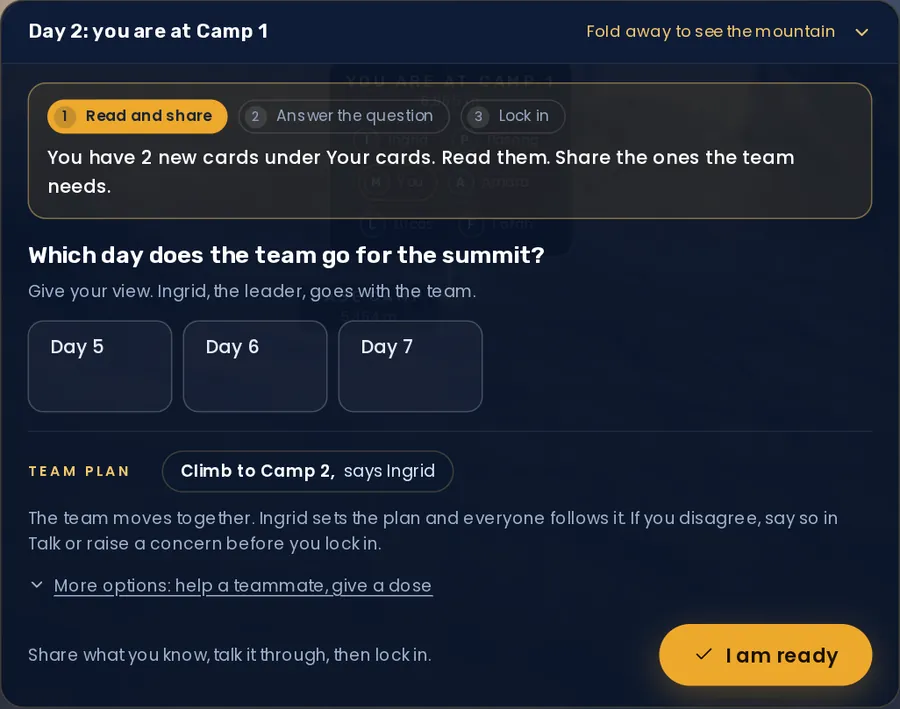
The middle panel. The gold box always says what to do now.
- The title says which day it is and which camp you are at.
- Step 1: read your new cards and share the ones the team needs.
- Step 2: answer today's question. You see the others' views after you give yours.
- Step 3: press I am ready. When everyone is ready, the day plays out.
- The team moves together. Only the leader sets the plan.
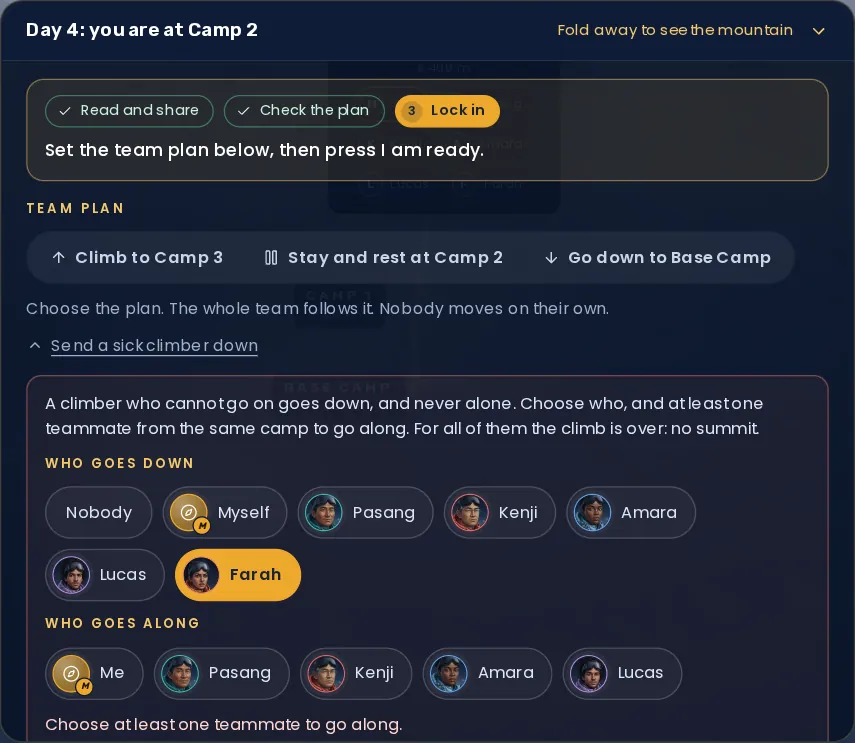
The leader sees two more controls in the middle panel.
- Team plan: each button names where it leads, such as Climb to Camp 3. Everyone follows it.
- Your order is shown in words before you lock in.
- Send a sick climber down: choose who, and at least one teammate to go along. For them the climb is over.
- If a climber collapses, this panel opens by itself and you choose who carries them down.
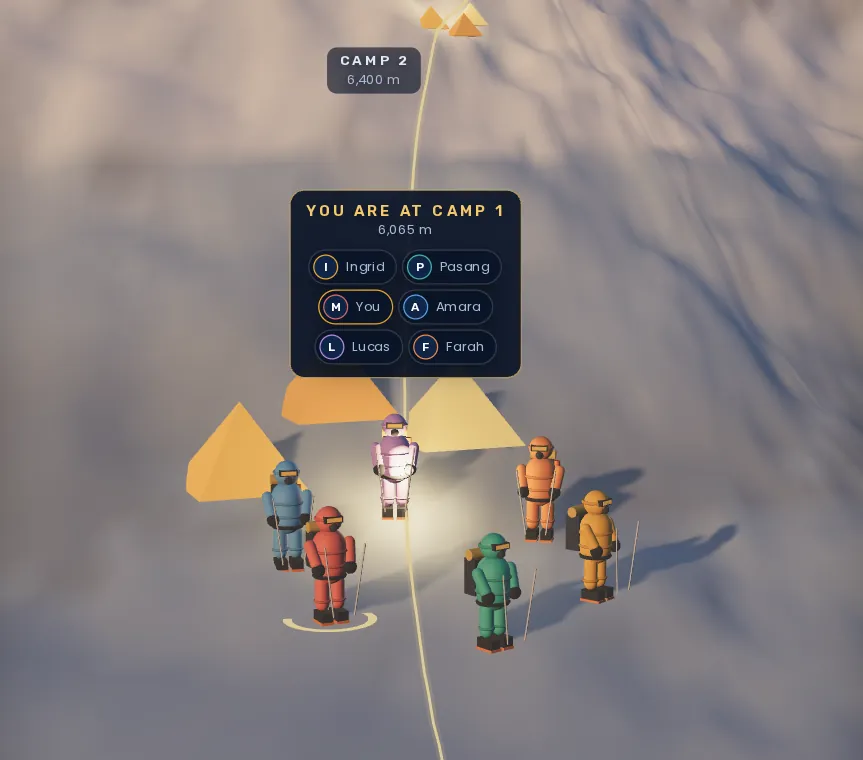
Click the bar at the top of the middle panel to fold it away and see the mountain.
- A gold box shows the camp you are at, with the names of everyone there.
- Drag to turn the mountain. Scroll to zoom.
- A white plume on the summit means the wind is too strong to climb to the top.
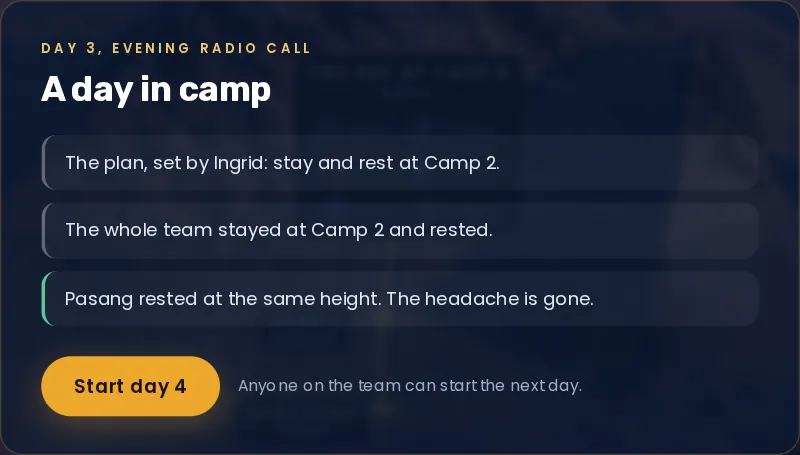
After everyone is ready, the evening radio call tells what happened.
- It opens with the leader's plan, then says who moved where and what it cost.
- Red lines are bad news. Read them: they explain the next day.
- Anyone on the team can start the next day.
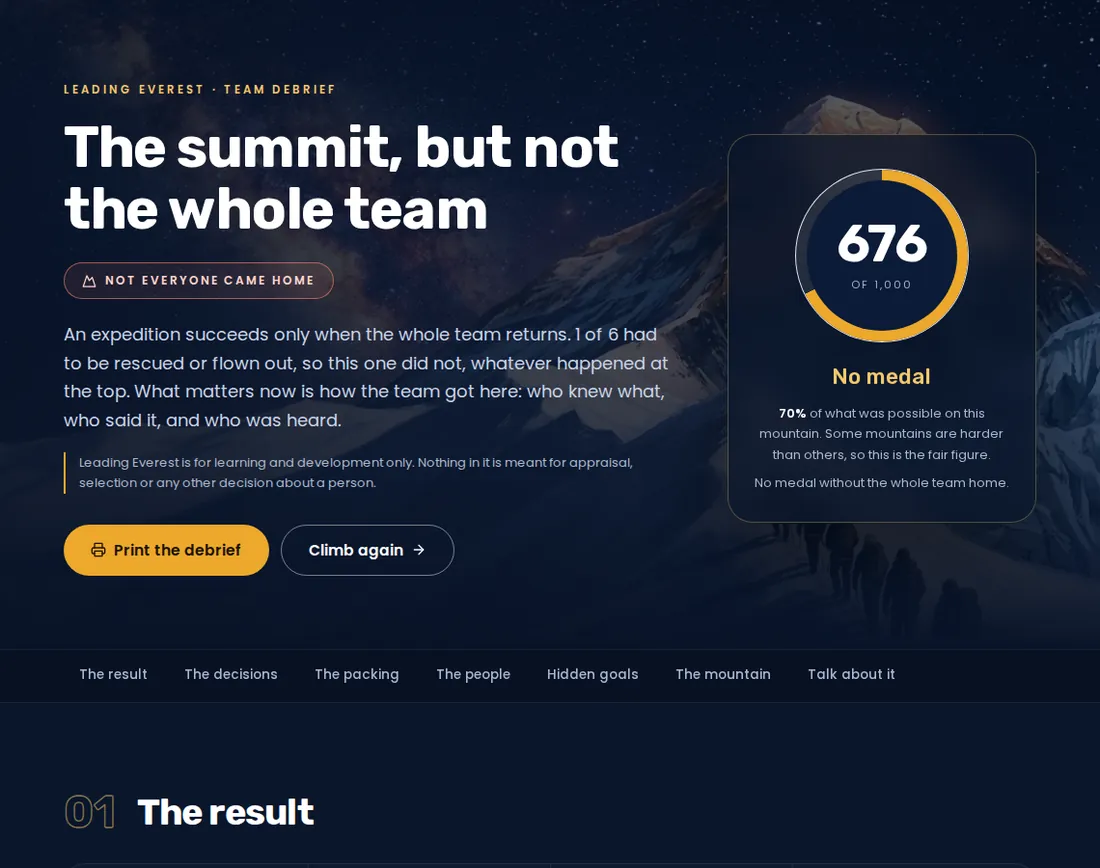
When the climb ends, the game shows what the team really did.
- The score, who came home safe and who reached the summit.
- Each decision, with the facts that were on the board and the ones that were not.
- Questions to talk about, and a button to print it.
The rules of the mountain
The team has a shared budget of USD 5,000. Each climber chooses what to carry. A heavier pack costs strength during the climb.
The team moves up one camp at a time. Going down is faster.
Nobody climbs or goes down on their own. Only the leader can send a sick climber down, and never alone: at least one teammate goes along. For both, the climb is over. If the leader's own climb ends, the strongest climber still going leads the team.
After the summit every climber still has to come down. The game ends when the team is safely off the mountain, not when someone reaches the top.
Each climber has a strength level from 1 to 100. Climbing uses strength. Rest restores it at the lower camps. At Camp 3 and above, nobody recovers.
Players see different information. The doctor sees the health of the team. Other players see what belongs to their role.
When a climber's strength falls under 25, they collapse and the team loses the safety points for them. At Camp 2 or lower a helicopter flies them out. Higher up they must be carried down: the leader chooses who carries them, and for the carriers the climb is over.
A summit attempt needs oxygen and a turnaround time. The expedition leader sets the summit rules for the team.
With two or more players, each day opens with 45 seconds of reading time. Nobody talks, shares or asks until it ends. Then you give your own view before you see the views of others.
Each day you can give 3 of your own strength to one teammate at your camp. It costs you exactly what it gives them.
Your team is not alone up there. On the way down, another team may need your help. The game does not grade what you decide.
Every role has personal objectives worth points. Some of them compete with what the team needs.
A successful expedition needs both: everyone home safely, and at least one climber on the summit. A summit cannot make up for leaving a teammate behind.
What will your team pack?
Before the climb begins, the team packs. Every item is a trade-off between weight, cost, safety and performance. There is one budget of USD 5,000 for the whole team, and every climber carries their own pack. Up to 6 kg costs nothing. Every 3 kg more costs 1 strength on each climbing day. Nobody can carry more than 14 kg. Everyone sees every pack.
Oxygen for summit day. Buying it is a choice, not a must: some bottles already wait at Camp 4, and the guide knows how many. A bottle you buy reaches Camp 4 when its carrier does.
- Weight4 kg
- PriceUSD 500
- Per climberUp to 3
Feeds one climber for two days above Base Camp. A team without food loses strength every day.
- Weight1 kg
- PriceUSD 60
- Per climberUp to 8
Short-term relief for a struggling climber. Only the doctor can carry and give it.
- Weight0.5 kg
- PriceUSD 150
- Per climberUp to 4
Helpers lose no strength when a climber has to be carried down from high on the mountain.
- Weight3 kg
- PriceUSD 200
- Per climberUp to 1
Better rest for everyone at Camps 1 to 3.
- Weight5 kg
- PriceUSD 400
- Per climberUp to 1
Without a spare set, weather reports stop after day 4.
- Weight0.5 kg
- PriceUSD 60
- Per climberUp to 1
A weather outlook every morning for all the days ahead, from day 1. Without it, the forecast for day 7 is a guess.
- WeightNone
- PriceUSD 800
- Per climberUp to 1
The filmmaker needs it to meet the filming goals.
- Weight6 kg
- PriceFree
- Per climberUp to 1
Halves the cost of a late summit for its owner and prevents frostbite.
- Weight1 kg
- PriceUSD 50
- Per climberUp to 1
Every decision has a cost
Climbing uses strength. Rest, food, equipment and team decisions protect it. Everyone starts between 82 and 95. Under 50 a climber is weak. Under 25 is an emergency.
- To Camp 1-5
- To Camp 2-4
- To Camp 3-9
- To Camp 4-11
- Camp 4 to the summit and back-22
- At Base Camp+10
- At Camp 1+5
- At Camp 2+6
- At Camp 3-2
- At Camp 4-9
- Down to Camp 2+4
- Down to Base Camp+8
- Each 3 kg in your pack above 6 kg, each climbing day-1
- A night without food and fuel-3
- Helping to carry a climber down, without spare rope-8
- Climbing in heavy snow-4
- A dose from the doctor, for one day+6
- Giving a hand to a teammate (they gain the same)-3
- Bringing a climber of another team down with you-6
- Each bottle missing on summit day-12
- Turned back by high wind above Camp 4-14
- Turning around below the summit-14
1,000 points
Safety carries the greatest weight. A summit never makes up for a climber who does not come home. The score is not the only outcome: the real learning is in how the team reached its decisions.
- 400Everyone home safely
- 250Summit achievement
- 250Personal objectives
- 100Strength at the end
Do
- Share important information early.
- Ask teammates what they know and how they are doing.
- Raise a concern when you disagree.
- Tell the team when you are struggling.
- Agree on the summit rules before the pressure rises.
- Keep talking to your team.
- Say it and share it. If it isn’t on the team board, the game doesn’t know it.
- Plan the descent before you commit to the ascent.
Do not
- Assume everyone sees what you see.
- Wait to be asked for information the team needs.
- Hide a weakness to protect a personal objective.
- Let the clock or the loudest voice make the decision.
- Chase the summit at any cost.
- Forget that reaching the top is only halfway.
- Show your screen to another player.
Want it on paper? Open the manual as a page you can print.
Running it for a group? Two ways to do it.
One team can simply start a climb. For a workshop with several teams, choose how you want to run it.
Run it yourself
Open a session, send each team its link and watch every climb from one screen.
- 1 to 10 teams at the same time
- A facilitator guide with the briefing and the debrief
- A two-minute tech check to send to your group
Let us run it for you
A Learning Everest facilitator runs the briefing, the climb and the debrief for your group.
- About two hours, in a room or online
- A debrief for each team
- A short note for the sponsor
The demo is free. The full game is paid per session: see the prices. Want the detail first? See what it measures or open a session now.
Ready to lead the climb?
Six people. One mountain. Incomplete information. What happens when the summit is within reach and your team has to choose between the goal and the people?
Start Leading Everest Reach the Summit. Bring Everyone Home.Every decision matters. Every climber matters. The mountain is the challenge. Your team is how you meet it.A leadership and team decision simulation from Learning Everest.