 Leading EverestHow to play: the game manual |
How to play: the game manualRead this once before your first climb. It takes about five minutes. It covers the goal, what you do each day, the screen, the rules of the mountain, the packing list, what each decision costs and how the score is built. The same manual is one click away inside the game, under Help. The goal The expedition succeeds only when all six climbers return safely. The summit comes second. A day in six stepsThe climb has eight days. Every day follows the same six steps.
The screen, part by partA picture of each part of the game, what it is for, and what to do there. 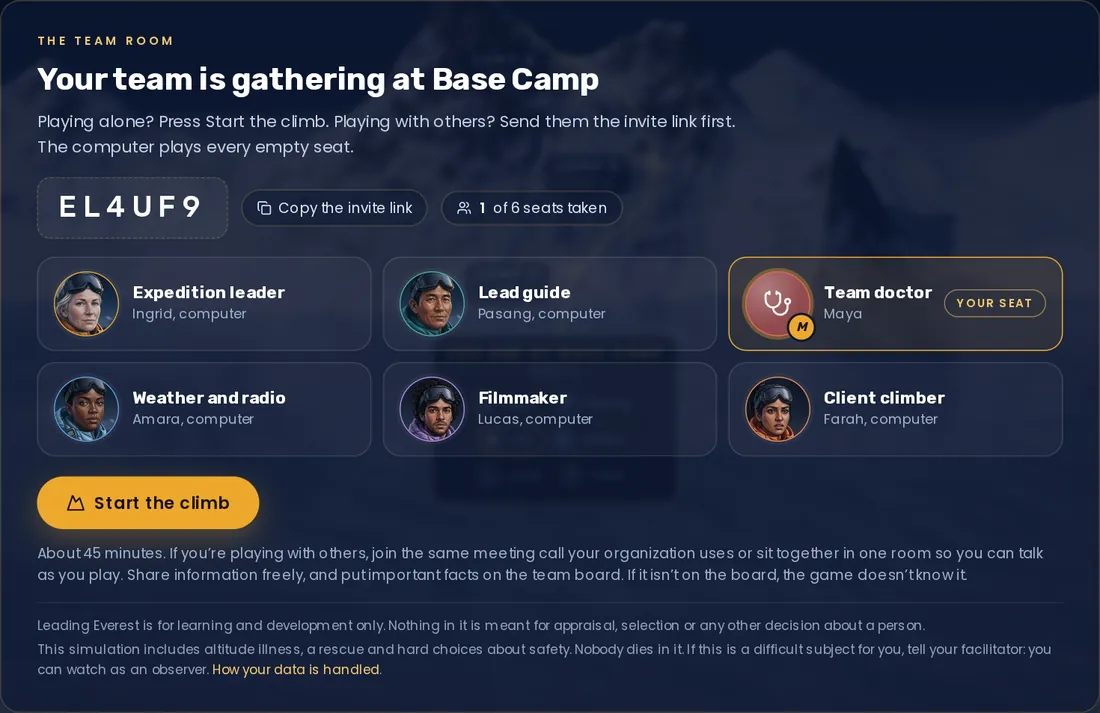 Where the climb begins. The team gathers here before the start.
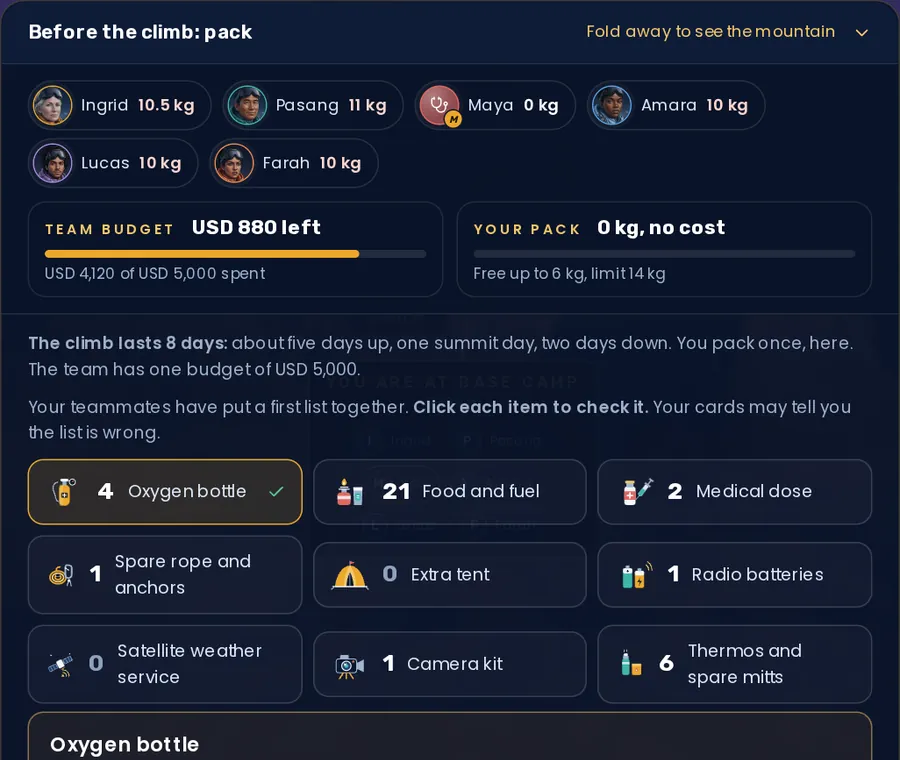 Before day 1 the team packs once. Nothing can be bought on the mountain.
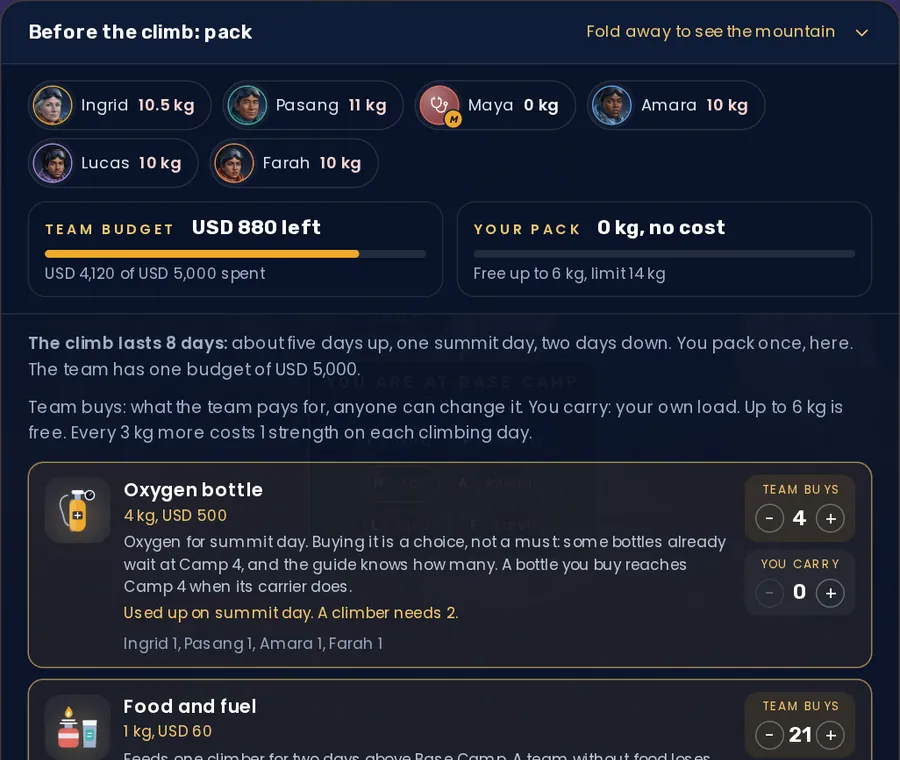 Press Change the list or my pack to open the full list.
 Always in view while you play.
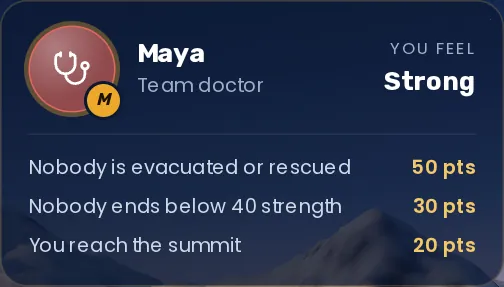 Top left. Your role, how you feel today, and your three personal goals.
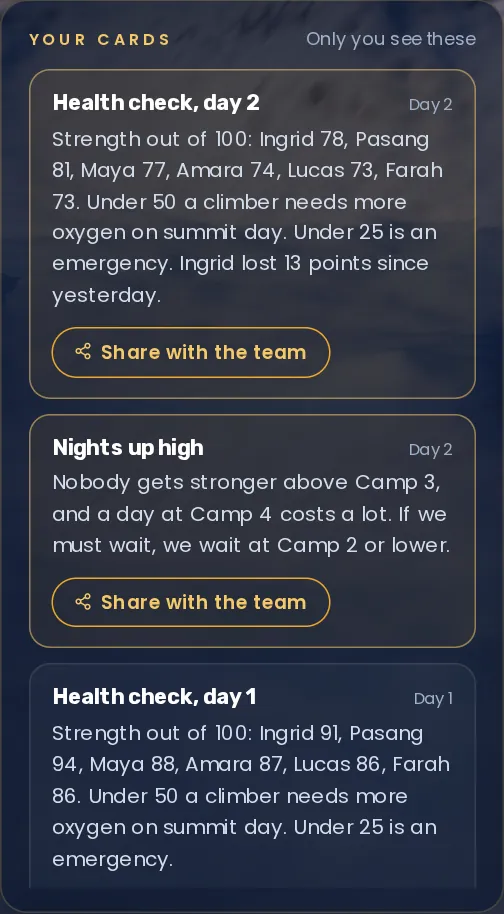 Left side. Facts that only you can see. New ones arrive each morning.
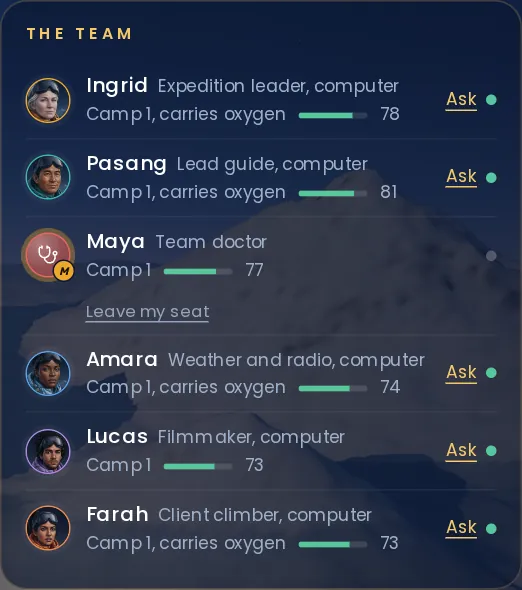 Top right. Where each climber is and what they carry.
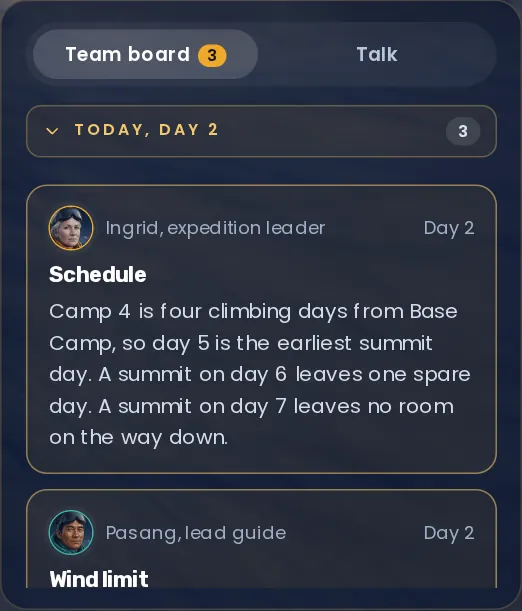 Bottom right. Every card that has been shared, for everyone to read.
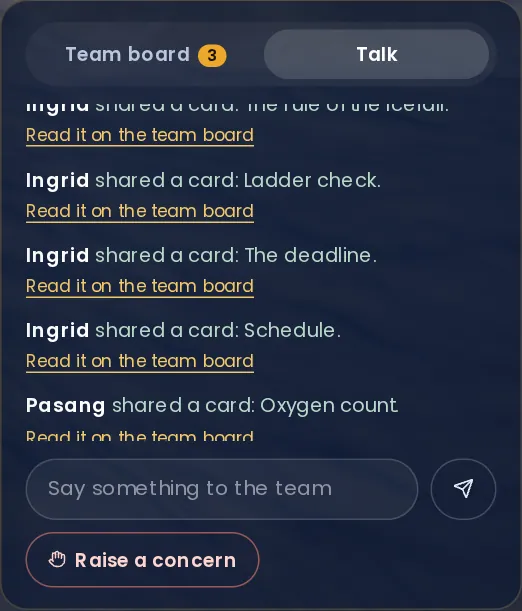 The second tab at the bottom right. The team chat.
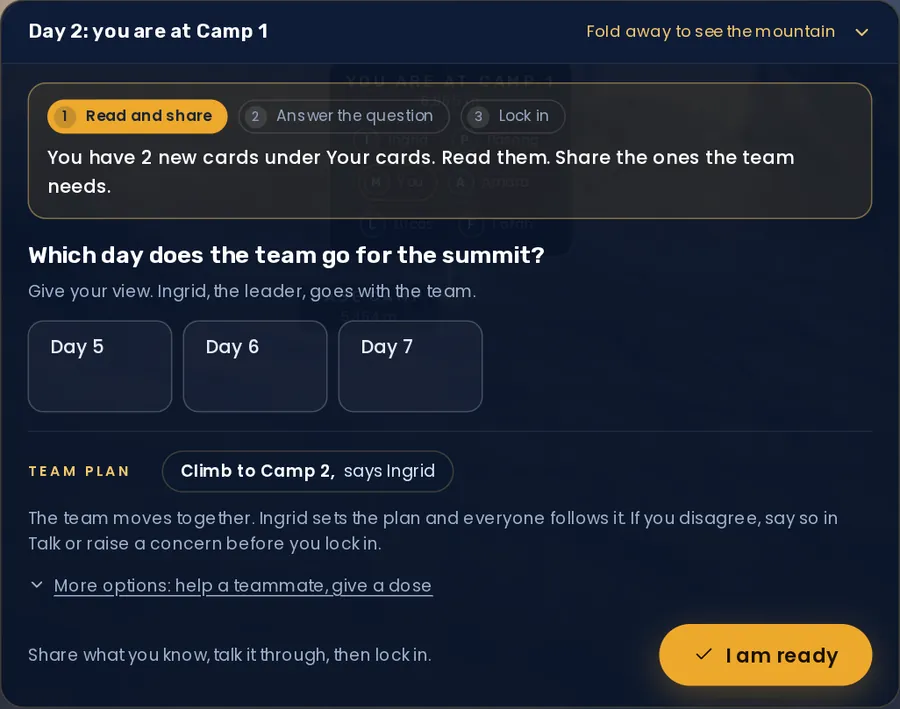 The middle panel. The gold box always says what to do now.
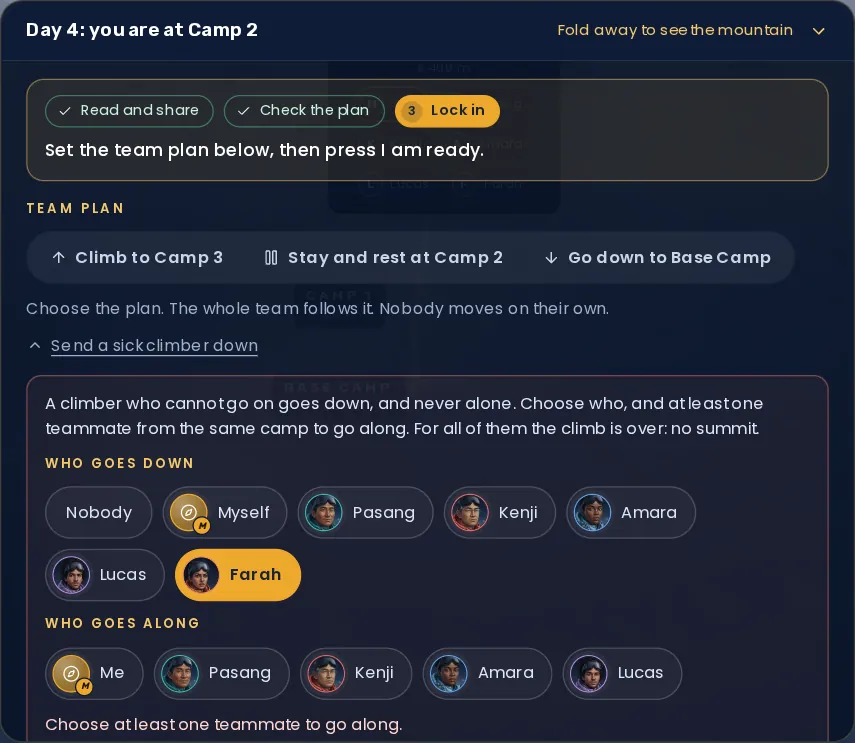 The leader sees two more controls in the middle panel.
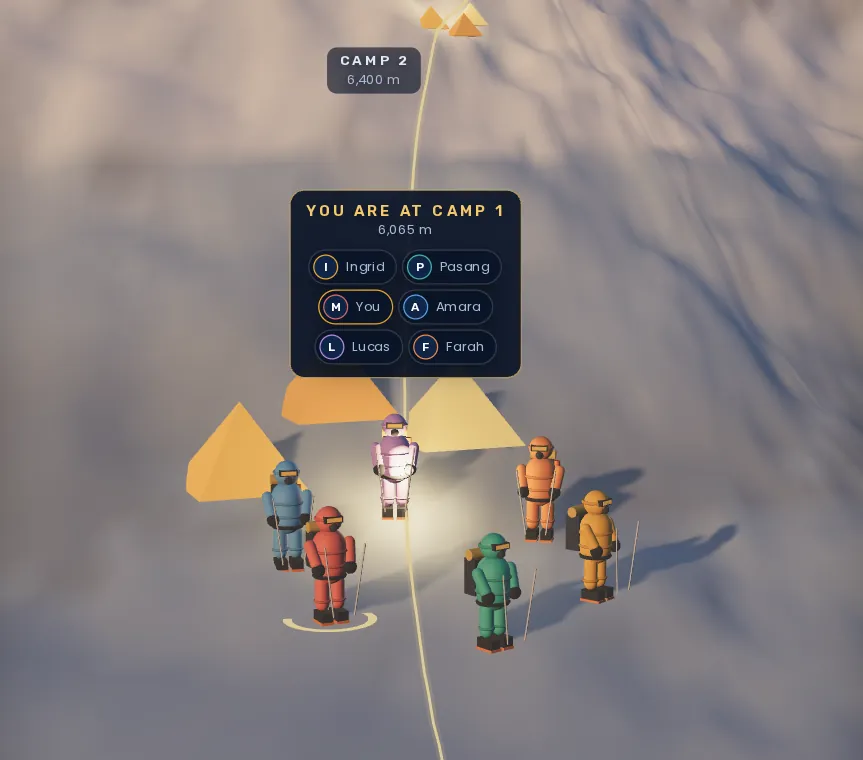 Click the bar at the top of the middle panel to fold it away and see the mountain.
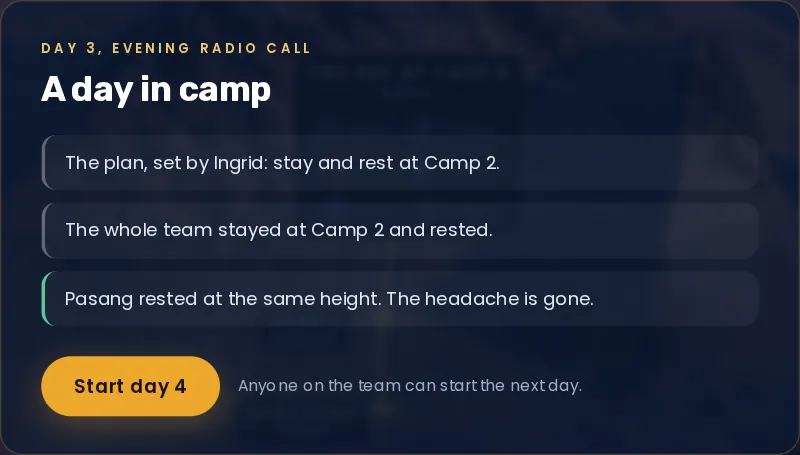 After everyone is ready, the evening radio call tells what happened.
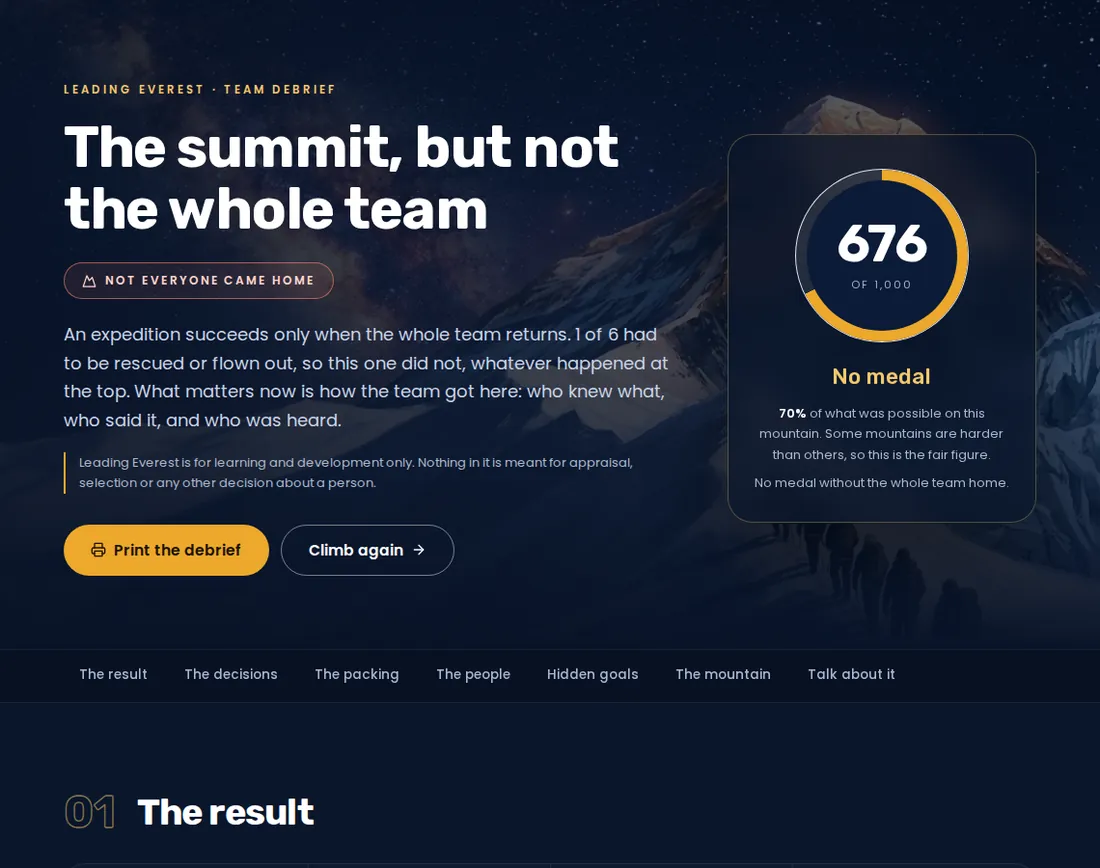 When the climb ends, the game shows what the team really did.
The rules of the mountain01USD 5,000 Pack at Base Camp The team has a shared budget of USD 5,000. Each climber chooses what to carry. A heavier pack costs strength during the climb. 028 days Eight days, up and down The team moves up one camp at a time. Going down is faster. 03One team The team moves together Nobody climbs or goes down on their own. Only the leader can send a sick climber down, and never alone: at least one teammate goes along. For both, the climb is over. If the leader's own climb ends, the strongest climber still going leads the team. 04Up and down The summit is only halfway After the summit every climber still has to come down. The game ends when the team is safely off the mountain, not when someone reaches the top. 051 to 100 Strength matters Each climber has a strength level from 1 to 100. Climbing uses strength. Rest restores it at the lower camps. At Camp 3 and above, nobody recovers. 066 views Information is not shared automatically Players see different information. The doctor sees the health of the team. Other players see what belongs to their role. 07Under 25 Emergencies When a climber's strength falls under 25, they collapse and the team loses the safety points for them. At Camp 2 or lower a helicopter flies them out. Higher up they must be carried down: the leader chooses who carries them, and for the carriers the climb is over. 08One window Summit day A summit attempt needs oxygen and a turnaround time. The expedition leader sets the summit rules for the team. 09Reading time First read, then talk With two or more players, each day opens with 45 seconds of reading time. Nobody talks, shares or asks until it ends. Then you give your own view before you see the views of others. 103 strength A hand for a teammate Each day you can give 3 of your own strength to one teammate at your camp. It costs you exactly what it gives them. 11No right answer Other people on the mountain Your team is not alone up there. On the way down, another team may need your help. The game does not grade what you decide. 12100 points each Personal goals Every role has personal objectives worth points. Some of them compete with what the team needs. 136 of 6 home No medal without everyone A successful expedition needs both: everyone home safely, and at least one climber on the summit. A summit cannot make up for leaving a teammate behind. What will your team pack?Before the climb begins, the team packs. Every item is a trade-off between weight, cost, safety and performance. There is one budget of USD 5,000 for the whole team, and every climber carries their own pack. Up to 6 kg costs nothing. Every 3 kg more costs 1 strength on each climbing day. Nobody can carry more than 14 kg. Everyone sees every pack. 01 Oxygen bottle Oxygen for summit day. Buying it is a choice, not a must: some bottles already wait at Camp 4, and the guide knows how many. A bottle you buy reaches Camp 4 when its carrier does.
02 Food and fuel Feeds one climber for two days above Base Camp. A team without food loses strength every day.
03Doctor only Medical dose Short-term relief for a struggling climber. Only the doctor can carry and give it.
04 Spare rope and anchors Helpers lose no strength when a climber has to be carried down from high on the mountain.
05 Extra tent Better rest for everyone at Camps 1 to 3.
06 Radio batteries Without a spare set, weather reports stop after day 4.
07 Satellite weather service A weather outlook every morning for all the days ahead, from day 1. Without it, the forecast for day 7 is a guess.
08Filmmaker only Camera kit The filmmaker needs it to meet the filming goals.
09 Thermos and spare mitts Halves the cost of a late summit for its owner and prevents frostbite.
Every decision has a costClimbing uses strength. Rest, food, equipment and team decisions protect it. Everyone starts between 82 and 95. Under 50 a climber is weak. Under 25 is an emergency. Climbing up
A day in camp
Going down
Extras
The team score 1,000 points Safety carries the greatest weight. A summit never makes up for a climber who does not come home. The score is not the only outcome: the real learning is in how the team reached its decisions.
Do
Do not
|
A leadership and team decision simulation from Learning Everest.Played on Global HR World · games.globalhrworld.com  |